
Best AI Tools for Digital Marketing: SEO, Content, Ads & Automation
Marketing teams that adopted AI tools early are no longer just experimenting — they're rebuilding their workflows around them. From SEO research to ad targeting to content drafts, AI has moved from "nice to have" to a default part of how marketing gets done.
If you're a business owner trying to figure out where AI actually fits into your marketing without wasting time or money, you're in the right place. This guide breaks down the real ai tools for digital marketing — what they do, how they work, and where to start. We'll cover SEO, content creation, paid ads, and automation, so you leave with a clear picture, not just a list of buzzwords.
What Are AI Tools for Digital Marketing — and Why Do They Matter?
AI marketing tools are software applications that use machine learning, natural language processing, or generative AI to automate, enhance, or accelerate marketing tasks. They're not replacements for strategy or creativity. Think of them as very fast, very tireless assistants who never sleep and never miss a data point.
The gap between businesses using AI well and those treating it as a novelty is widening every quarter. Teams that build AI into their actual workflow — not just as an occasional shortcut — consistently produce more content, run more ad variations, and respond to data faster than teams that don't.
The Four Pillars of AI in Marketing
Before diving into specific tools, it helps to understand where AI creates the most impact:
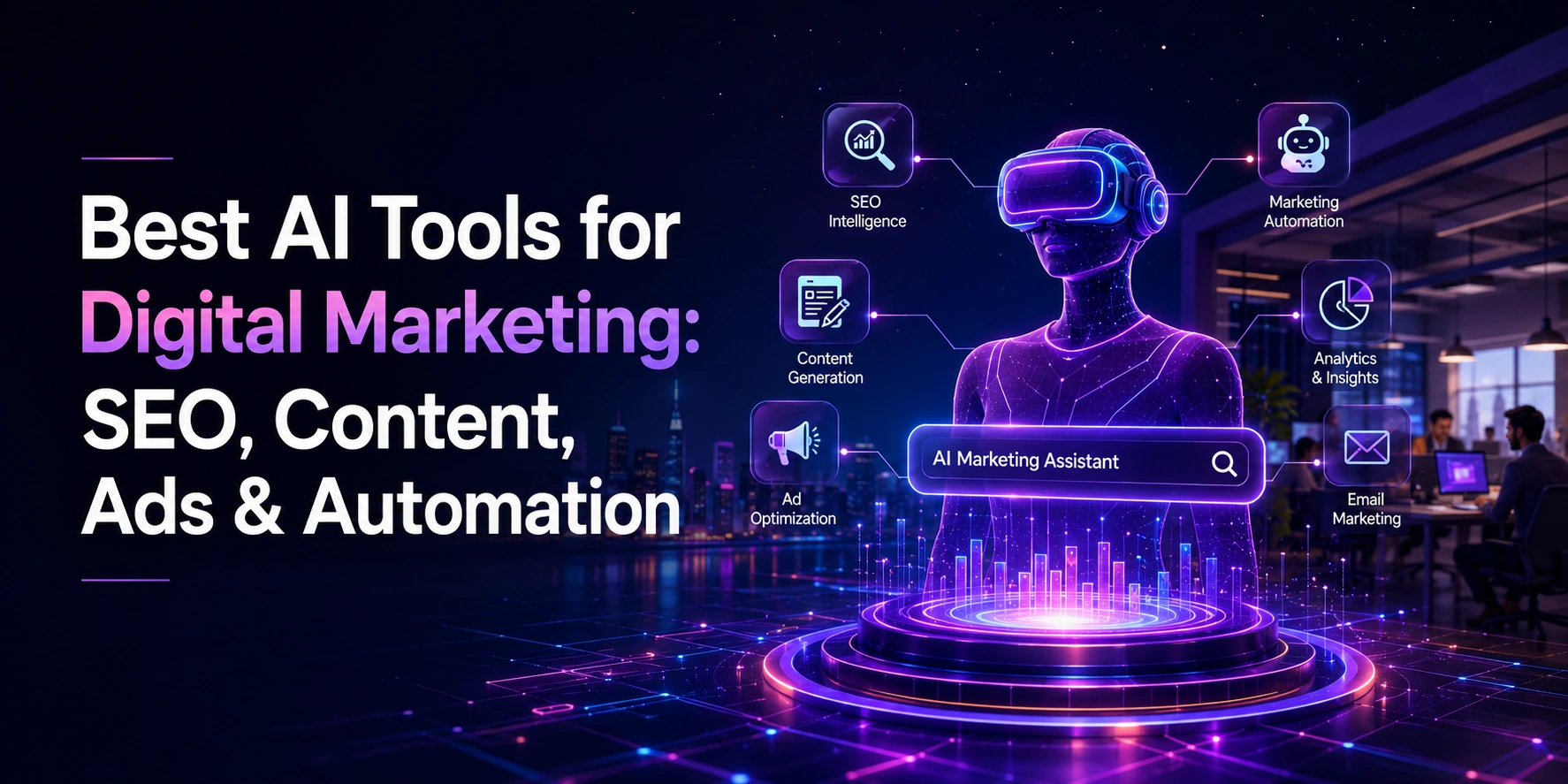
SEO and keyword research — identifying what your audience searches for and how to rank for it
Content creation and optimization — drafting, editing, and improving written and visual content
Paid advertising — automating bidding, audience targeting, and ad copy testing
Marketing automation — personalizing email sequences, lead scoring, and customer journeys
Each of these has dedicated tools. But the smartest marketers aren't using one — they're building a connected stack. If you're starting from scratch, our guide on how to do digital marketing for business in 2026 walks through how SEO, content, social, and ads fit together before you start layering AI on top.
How Is AI Used in Digital Marketing? A Practical Breakdown
The answer depends on what part of marketing you're focused on. Let's walk through each area practically.
AI for SEO: Research Faster, Rank Smarter
Keyword research used to take days. Tools like Semrush, Ahrefs, and Surfer SEO now use AI to surface keyword clusters, competitive gaps, and content opportunities in minutes. More importantly, they show you why a page ranks — not just the keyword it targets.
AI-powered SEO tools also help with technical audits. They scan your site, flag issues, and often suggest fixes — tasks that previously required a specialized developer. This matters more than ever because search itself is changing: Google's own guidance now covers optimizing content for generative AI search alongside traditional ranking factors, which means technical SEO and AI visibility are increasingly the same job.
For Indian businesses specifically, the digital marketing AI tools India context matters. Search behavior in India is increasingly voice-driven and regional. Tools that support vernacular keyword research — like Google's own Keyword Planner with regional filters — give local businesses a real edge. For a deeper look at whether traditional SEO still pays off alongside these AI-driven changes, see Is SEO Still Worth It for Small Businesses in India in 2026?
AI for Content Marketing: From Blank Page to Published Post
Generative AI for marketing content has matured significantly. ChatGPT, Claude, Gemini, and Jasper can now produce first drafts, headlines, meta descriptions, email subject lines, and social media captions at scale.
But here's the thing — the output is only as good as your input. Generic prompts produce generic content. The real skill is learning to write detailed briefs that produce usable output. Teams that treat AI as a co-writer rather than a ghostwriter consistently get better results.
A practical workflow looks like this:
Define your topic, audience, and goal clearly
Use AI to generate an outline or first draft
Edit heavily for brand voice, accuracy, and depth
Run through an SEO tool for optimization before publishing
At DigitalAdda, this is exactly how we structure content production for clients: AI handles the first-draft volume, while strategists and editors handle brand voice, factual accuracy, and the local market context that AI tends to miss. The result is content that publishes faster without reading like it was written by a machine. If you want to see how this fits into a broader content plan, our guide on building a content marketing strategy for startups in India covers the planning side in more depth.
Best AI Tools for Marketers in 2026: Category by Category
This is where most guides go wrong — they list 30 tools with no context. Here's a curated breakdown that actually helps you decide.
For SEO and Content Optimization
Surfer SEO connects directly to Google Search Console and tells you what changes would improve a page's ranking, based on real-time competitive analysis rather than guesswork. Pair it with a writing tool like ChatGPT and you've got a content production system that's hard to beat on efficiency.
Semrush's AI Writing Assistant is worth mentioning for businesses that want an all-in-one platform. It's not the most powerful individual tool, but the integration with keyword data makes it practical for teams that already live inside Semrush.
For Paid Ads and Conversion
Google's Performance Max campaigns use AI to automatically serve ads across Search, YouTube, Display, Gmail, and Maps. You provide the assets and goals; Google's machine learning handles placement and bidding — useful for businesses that don't have the bandwidth to manage placements channel by channel.
Meta's Advantage+ Shopping Campaigns do something similar for e-commerce brands on Facebook and Instagram. The AI tests creative combinations automatically — a major time-saver for businesses running multiple ad variants. If you're deciding where to put your ad budget in the first place, our comparison of Google Ads vs Facebook Ads for Indian businesses is a useful starting point.
For Automation and Personalization
HubSpot's AI features, now embedded across their CRM, help with lead scoring, email personalization, and predictive deal forecasting. For a business owner managing a sales pipeline alongside marketing, this kind of unified AI is genuinely useful — not just impressive on a demo call.
Zapier AI and Make allow you to build automated workflows that connect your tools without writing code. Imagine a lead filling out a form on your website — AI scores them, routes them to the right sales rep, triggers a personalized email sequence, and logs everything to your CRM.
Here's the tools summary table:
Tool
Category
What it does
Best for
Surfer SEO
SEO & content optimization
Connects to Google Search Console, runs real-time competitive analysis, and shows specific changes to improve rankings
Pairing with a writing tool for an efficient content production system
Semrush AI Writing Assistant
SEO & content optimization
All-in-one platform combining keyword data with AI-assisted writing
Teams already using Semrush who want one integrated platform
ChatGPT / Claude / Gemini
Content creation
Generate drafts, headlines, meta descriptions, email subject lines, and social captions at scale
Brainstorming, ideation, and first drafts when given detailed context
Jasper
Content creation
Generative AI tuned for marketing copy and brand voice
Teams producing high-volume branded content
Google Performance Max
Paid ads & conversion
AI automatically places and bids ads across Search, YouTube, Display, Gmail, and Maps
Businesses without bandwidth to manage channel-by-channel placement
Meta Advantage+ Shopping
Paid ads & conversion
AI tests ad creative combinations automatically for e-commerce
Facebook/Instagram e-commerce brands running multiple ad variants
HubSpot AI (CRM)
Automation & personalization
Lead scoring, email personalization, predictive deal forecasting
Businesses managing sales pipeline alongside marketing
Zapier AI / Make
Automation & personalization
No-code automated workflows connecting marketing tools (scoring, routing, email sequences, CRM logging)
Automating lead handoff and follow-up without development resources
Google Keyword Planner (regional filters)
SEO & keyword research
Vernacular and regional keyword research
Indian businesses targeting voice-driven, regional search behavior
Is ChatGPT Useful for Digital Marketing? An Honest Assessment
ChatGPT for marketing India has become a common search because it's the most recognized AI tool. And the honest answer: yes, it's useful — but not in the way most people use it.
Most business owners open ChatGPT, type "write me a blog post about X," and get something generic and forgettable. That's not the tool's fault — it's the brief. ChatGPT becomes genuinely powerful when you give it context: your audience, your brand voice, your competitors, your existing top-performing content.
Used well, ChatGPT can help you:
Brainstorm campaign angles and ad hooks
Draft and iterate email subject lines rapidly
Summarize customer feedback into actionable themes
Build content calendars based on keyword strategy
It's a thinking partner, not a publishing machine. The moment you treat it like a vending machine, the output quality drops.
Can AI Replace Digital Marketers?
This question comes up constantly, and it deserves a straight answer: no — but it will replace marketers who don't use AI.
AI tools handle volume, speed, and pattern recognition better than any human. But they don't understand your customer's emotional context, your brand's history, or the cultural nuance that makes a campaign resonate in a specific market.
What's actually happening in agencies and in-house teams is a shift in roles. Marketers who once spent most of their time on execution now spend that time on strategy, oversight, and creative direction — with AI handling the rest. It's a better use of human intelligence, not a replacement of it.
This shift is also changing where customers find businesses in the first place. Search itself is evolving toward AI-generated answers, which is why visibility inside tools like ChatGPT and Google AI Overviews is becoming as important as traditional rankings. Our guide on Google AI Overviews and what Indian businesses need to know about SEO in 2026 breaks down what that shift means in practice.
At DigitalAdda, we combine AI-powered content production and SEO tools with strategists who understand local market behavior and brand positioning. For one recent client, this approach took their organic blog traffic from a handful of monthly visitors to several thousand within a few months — a result that came from pairing AI-assisted production speed with human-led strategy, not from AI alone.
Relatable Readings: AI Jobs in India Salary 2026
Q&A: Common Questions About AI in Digital Marketing
Q: What are the best AI marketing tools in 2026 for small businesses?
A: For most small businesses, the best starting stack is Surfer SEO or Semrush for keyword and content optimization, ChatGPT or Claude for drafting and ideation, and HubSpot or Mailchimp's AI features for automation. Start with one area — content or SEO — and expand from there. Trying to adopt everything at once leads to confusion, not results.
Q: Can AI help with SEO and content marketing specifically?
A: Yes, and it's one of the clearest use cases. AI tools can identify keyword gaps, suggest content topics based on search intent, generate optimized drafts, and analyze why competitor pages rank higher. The key is combining AI output with genuine subject-matter expertise — search engines and readers both reward depth, which still requires human knowledge.
Q: How is AI used in digital marketing for lead generation?
A: AI improves lead generation by scoring leads automatically based on behavior, personalizing outreach based on customer data, and optimizing ad targeting to reach higher-intent audiences. Tools like HubSpot's predictive lead scoring and Google's Performance Max campaigns are practical examples businesses can deploy relatively quickly.
Key Takeaways
AI tools for digital marketing work best as force multipliers, not standalone solutions.
The biggest gains come from SEO automation, content workflows, and paid ad optimization.
ChatGPT and similar tools require detailed, strategic prompts to produce usable output.
AI won't replace digital marketers — it will replace those who refuse to adapt.
Start with one AI tool in one channel, prove the ROI, then scale your stack.
Conclusion
The real question isn't whether AI tools for digital marketing are worth using — that's already settled. The question is whether you're building a system around them or just experimenting randomly. Start focused: pick one channel, choose one tool that solves a real issues, and measure what changes. From there, you expand with confidence rather than guesswork.
AI gives you speed. Strategy gives you direction. The combination is what actually grows a business.