
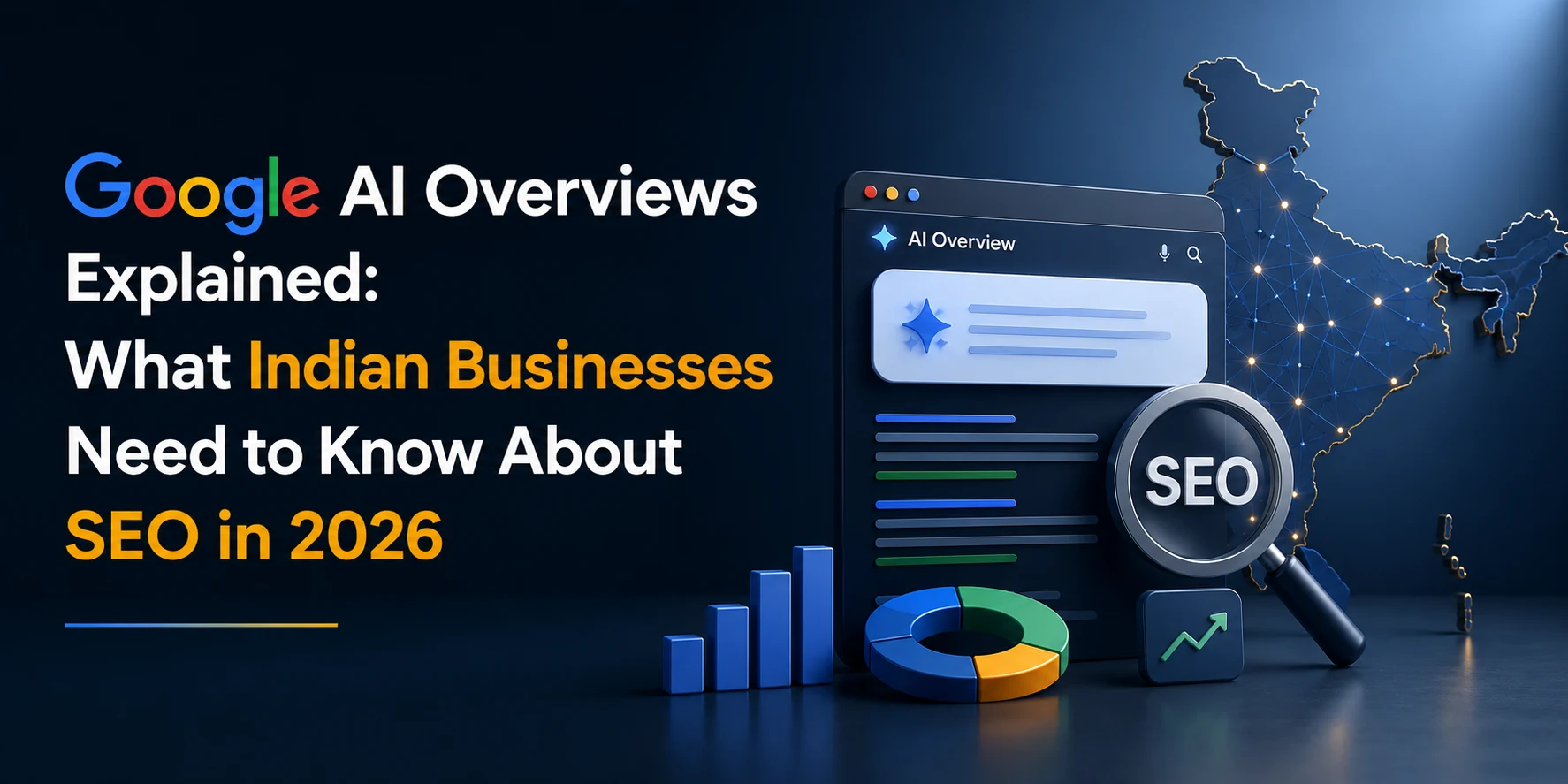
Google AI Overviews Explained: What Indian Businesses Need to Know About SEO in 2026
Something quietly changed in how Indians search online — and most business owners haven't caught on yet.
Open Google on your phone and search "best accounting software for small businesses in India." Before you see a single website link, you'll likely see a paragraph-long AI-generated answer sitting right at the top. No clicking required. Google just... answered it.
That's a Google AI Overview. And if your business isn't part of that answer, you've essentially become invisible to a growing chunk of your potential customers.
This post breaks down what AI Overviews actually are, how they're changing SEO for Indian businesses specifically, and — most importantly — what you can do to stay visible in 2026.
What Are Google AI Overviews?
Google AI Overviews (formerly called Search Generative Experience or SGE) are AI-generated summaries that appear at the very top of Google search results. Instead of showing you ten blue links and letting you decide, Google now synthesises information from multiple sources and presents a direct answer — with citations.
They were launched in the US in May 2024, and by August 2024, they were live in India. Today, AI Overviews are available in over 200 countries and support multiple Indian languages including Hindi, Tamil, and Telugu.
The scale is significant. As of mid-2025, Google AI Overviews had crossed 2 billion monthly users globally — making them not an experiment but the new default.
Are AI Overviews Live in India? Yes — and Growing Fast
This is the first question most Indian business owners ask. The answer is yes, and the rollout is accelerating.
India is one of Google's priority markets for AI search. In April 2026, Google broke ground on an AI infrastructure hub in Visakhapatnam as part of a ₹1.25 lakh crore (approximately $15 billion) five-year investment in India's AI ecosystem. That's not a coincidence — it's a signal that AI-powered search is being built for India, not just translated into it.
AI Mode — Google's next step beyond AI Overviews, which offers a fully conversational search experience — is already active in India. And Google has publicly committed to expanding regional language support for AI search across Hindi, Tamil, Telugu, Kannada, Bengali, and Marathi.
For Indian business owners, this is the moment to pay attention.
How Do AI Overviews Affect SEO? The Honest Answer
Let's not sugarcoat this: AI Overviews are reducing clicks to traditional organic results. Multiple large-scale studies in 2025–2026 confirm this, and the data is consistent.
Pew Research Center analysed 68,000 real queries and found click rates dropped from 15% to 8% when AI Overviews appeared — a nearly 47% relative decline.
Ahrefs measured a 58% drop in click-through rate for #1 ranked pages when AI Overviews were present.
As of March 2026, AI Overviews appear on 48% of all Google searches — up from 34.5% just three months earlier.
Those numbers are uncomfortable if your entire traffic strategy depends on ranking #1 and waiting for clicks.
But here's the part most people miss: sites that are cited inside AI Overviews can actually see CTR increases of up to 35% compared to sites that rank but aren't cited. The traffic shifts from volume to quality — fewer clicks, but from people who already trust what they're clicking on.
The goal in 2026 isn't just to rank. It's to be the source Google's AI chooses to cite.
What This Means Specifically for Indian Businesses
The Indian context adds a few layers that global SEO guides tend to skip entirely.
The mobile reality. Over 75% of Indian searches happen on smartphones. When AI Overviews and featured snippets appear together on mobile, they can occupy up to 75.7% of the screen before a single organic result appears. If your content isn't structured to be extracted and cited, it may not be seen at all — even if you're ranking on page one.
The regional language opportunity. This is the most underrated SEO opportunity in India right now. Google's AI Overviews now generate answers in Hindi and other Indian languages for queries made in those languages. But here's the gap: almost no Indian businesses have structured, authoritative content in regional languages that AI can extract and cite. Businesses targeting Tier 2 and Tier 3 cities in Hindi, Tamil, or Telugu are competing against almost no one for AI citation in those languages. That's a first-mover advantage that won't last long.
The local search dimension. Google increasingly personalises AI search results by geography and language. A business in Jaipur that genuinely answers questions relevant to Jaipur customers — in their language, with their context — is more likely to surface in local AI Overviews than a generic national brand with better domain authority.
Must Read: Proven GBP Optimisation Tips for More Traffic & Leads
Zero-click searches are rising. India is already seeing a surge in zero-click behaviour, where users get their answer from the AI Overview and never visit a website. For informational queries, this is the new normal. Businesses that publish useful educational content should understand that the value isn't always a direct click — it's brand recall, authority building, and appearing in the AI's answer for questions your potential customers are asking.
How Can Indian Businesses Appear in AI Overviews?
The good news: Google has been clear that there are no secret tricks. AI Overviews draw from the same index as traditional search. Strong SEO fundamentals are still the foundation. But the layer on top — what makes content AI-citation-worthy — requires a different approach to how you write and structure content.
Here's what actually works:
1. Answer the question immediately. Google's AI extracts content in roughly 130–160 word blocks. If your answer is buried three paragraphs into the article after a long introduction, the AI can't find it easily. Lead every section with a direct, complete answer. Then add context, examples, and depth below it.
2. Structure content for extraction. Use clear H2 and H3 headings. Write each section so it makes sense on its own — as if someone landed on that paragraph without reading anything else. Comparison tables, numbered steps, and definition blocks are formats that AI Overviews cite most frequently.
3. Source your claims. This is the single most overlooked factor. Unsourced statistics are invisible to AI. When you reference a data point, name the source inline: "according to [Source], [stat]." Content with attributed, verifiable claims is significantly more likely to be cited than content that asserts facts without backing.
4. Build topical authority, not just individual pages. AI Overviews prefer to cite sources that have consistent depth across a topic. A single well-written article rarely earns a citation if the rest of your site has nothing related to it. Build a cluster of interconnected content around your core subject areas.
5. Add author credentials. E-E-A-T (Experience, Expertise, Authoritativeness, Trustworthiness) isn't just a Google guidelines concept — it's actively used to filter which sources AI Overviews trust. Every article needs a visible author with a real bio and verifiable background. Anonymous content is a liability in the AI search era.
6. Fix your technical basics. AI Overviews still draw from Google's index. If your pages aren't crawled, if your Core Web Vitals are poor (especially on mobile), or if you have no schema markup, the AI simply won't find your content. Implement Article schema with author and date fields. Implement FAQPage schema for FAQ sections. These give Google structured signals it can extract cleanly.
7. Optimise for voice and conversational queries. India's Tier 2 and Tier 3 city users increasingly search using voice — in Hindi, Telugu, and other regional languages. Voice queries are naturally conversational: "कौन सा accounting software छोटे business के लिए अच्छा है?" If your content is written only for English keyword matches, you're invisible to this growing segment.
What Traditional SEO Still Gets You (and What It Doesn't)
A fair question is whether traditional SEO — keyword research, backlinks, page speed — is still worth investing in. The answer is yes, but with an updated understanding of what you're optimising for.
Traditional SEO still determines whether Google indexes and finds your content at all. Without it, nothing else works. AI Overviews don't replace the index — they sit on top of it.
What's changed is the outcome of ranking. Ranking #1 in 2022 meant capturing 30–35% of clicks for that keyword. Ranking #1 in 2026, when an AI Overview is present, means capturing a fraction of that — unless you're also cited in the Overview itself.
The businesses that will win are those doing both: maintaining strong SEO so their content gets indexed and ranked, while also structuring that content so Google's AI chooses it as a citation source.
The Future of SEO in India With AI Overviews
Google I/O 2026 in May introduced Search Agents — AI agents that scan the web continuously on behalf of users, even without them actively searching. The direction of travel is clear: AI is moving from answering questions to anticipating them.
For Indian businesses, the practical implications over the next 12–18 months include:
Regional language AI search will become mainstream. Businesses with no Hindi or vernacular content will be invisible to a massive and growing segment.
Transactional queries (price comparisons, service bookings, product searches) will see more AI interference in the results page.
Brand authority will matter more than ever — businesses mentioned repeatedly in AI responses see measurably higher trust and direct search volume.
Google Search Console will be the essential tool for tracking AI Overview impressions, not just clicks. Impressions in an AI-cited context have value beyond direct traffic.
Key Takeaways
Google AI Overviews are live and expanding in India, with 2 billion monthly users globally and growing fast.
AI Overviews reduce organic CTR by up to 47–58% for queries where they appear — but being cited inside them can increase CTR by up to 35%.
India has a unique regional language opportunity — Hindi, Tamil, Telugu, and other vernacular AI citation slots are nearly unclaimed by Indian businesses right now.
To be cited, lead with direct answers, structure content for extraction, source every claim, and build topical depth.
Traditional SEO fundamentals still matter — AI Overviews draw from the same index. But the goal now is citation, not just ranking.
Author credentials and E-E-A-T signals are no longer optional — they're a filtering mechanism for AI source selection.
FAQ
Q: What are Google AI Overviews?
Google AI Overviews are AI-generated summaries that appear at the top of Google search results, synthesising answers from multiple web sources and citing them inline. They were previously called Search Generative Experience (SGE) and are now the default search experience in over 200 countries, including India.
Q: Are AI Overviews available in India?
Yes. AI Overviews have been available in India since August 2024. AI Mode — the next stage of AI-powered search — is also active in India. Google has committed to expanding support for Hindi, Tamil, Telugu, Kannada, and other Indian regional languages.
Q: Can AI Overviews reduce my website traffic?
Yes, they can reduce clicks to traditional organic results. Research shows click-through rates drop by 47–58% on queries where AI Overviews appear. However, businesses that are cited inside AI Overviews can see increased CTR of up to 35%. The goal is to be a cited source, not just a ranked page.
Q: How do AI Overviews change search rankings?
Your traditional search ranking still matters — it determines whether Google's AI considers your content at all. But ranking alone is no longer enough. Content structure, sourced claims, author credibility, and topical depth determine whether you're cited in the Overview that sits above the rankings.
Q: How can Indian businesses optimise for AI search?
Lead every section with a direct answer to the question it addresses. Use clear headings, comparison tables, and numbered steps. Source all statistics with named references. Build content clusters around your core topics. Add visible author bios. Implement schema markup. And if your customers search in Hindi or other regional languages, publish content in those languages — the competition for AI citation there is extremely low.
Q: What is the future of SEO with AI Overviews?
SEO is expanding, not dying. The future requires optimising for AI citation alongside traditional ranking — a practice called Generative Engine Optimisation (GEO). Businesses that build authoritative, well-structured, multilingual content will have an increasing advantage as AI search becomes the default way Indians discover products and services online.
Looking to build a content strategy that gets your business cited in Google AI Overviews? Talk to the DigitalAdda team — we work specifically with Indian SMEs on AI search visibility.