

How to Calculate Your Digital Marketing ROI: A Simple Framework for Indian Businesses
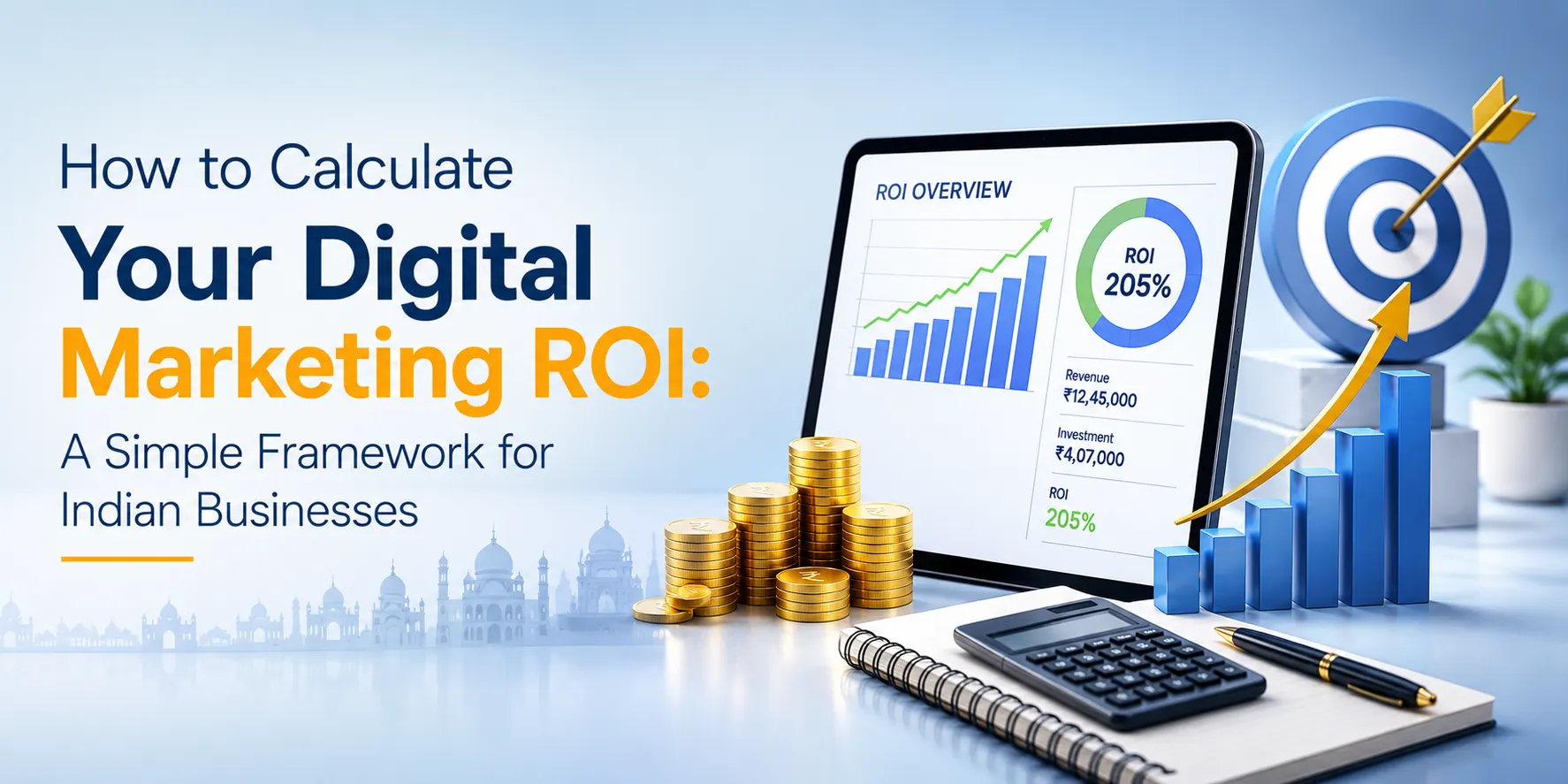
Most Indian business owners have spent money on digital marketing. Far fewer can tell you, with any confidence, whether it actually worked.
Not because the results weren't there — but because nobody ever showed them how to measure it properly. The agency sent a report full of impressions, reach, and engagement rate. The business owner nodded, paid the invoice, and hoped the phones would ring more this month than last.
This guide fixes that. It is a complete walkthrough of digital marketing ROI calculation for Indian businesses — what return on investment in marketing actually means, how to calculate it for the channels you're already using, and the mistakes that cause most businesses to either undercount or overcount their returns.
Key Takeaways
ROI in digital marketing is not about impressions or followers. It is about revenue generated versus money spent.
The core formula is simple: ROI (%) = [(Revenue from marketing – Marketing spend) ÷ Marketing spend] × 100.
Different channels — SEO, paid ads, social media, email — require different measurement approaches, and mixing them up produces misleading numbers.
Attribution — understanding which touchpoint actually drove a conversion — is the hardest part of the calculation and the most commonly ignored.
A good agency should be giving you this data in plain language every month, not burying it in charts.
Why Most Indian Businesses Can't Answer "Is My Marketing Working?"
The honest answer is that most can't answer this because they were never asked to track it properly from the start.
When a campaign goes live, the instinct is to watch follower counts, reach, and likes — because those numbers are visible, immediate, and feel like evidence that something is happening. The problem is that none of those numbers directly connect to revenue. A post can go viral and generate zero paying customers. A single, unglamorous Google Ad campaign with a modest budget can quietly generate forty qualified leads a month.
The metric that matters is always some version of: how much did I spend, and how much did I get back? Everything else is context for understanding why the number is what it is.
The Core ROI Formula for Digital Marketing
The foundational return on investment marketing calculation is straightforward:
ROI (%) = [(Revenue from marketing – Marketing spend) ÷ Marketing spend] × 100
A practical example: You spend ₹50,000 on Google Ads in a month. Those campaigns can be traced to ₹2,00,000 in confirmed revenue (through lead tracking, CRM data, or direct sales attribution). Your ROI is [(2,00,000 – 50,000) ÷ 50,000] × 100 = 300%.
That means for every rupee spent, you got four rupees back — three rupees of net return. That is a strong result. Many businesses would be very comfortable with a 200–300% ROI on paid advertising.
What counts as "good" ROI depends on your industry, margins, and business model. A real estate developer closing one ₹80 lakh property from a ₹40,000 ad spend has an extraordinary ROI even if it only happens twice a year. A coaching institute filling twenty-five seats at ₹15,000 each from the same spend is looking at a completely different calculation.
The formula never changes. What changes is what you put into it.
What to Include in "Marketing Spend"
This is where most calculations go wrong. Businesses count the ad budget but forget everything else. A complete marketing spend figure should include:
Ad spend — the actual money paid to Google, Meta, or any other platform.
Agency retainer or freelancer fees — if you're paying someone to manage your campaigns, that cost belongs in the calculation.
Content and creative costs — video production, graphic design, copywriting, photography.
Tools and software — SEMrush, Canva Pro, email platforms, CRM subscriptions used specifically for marketing.
Your own time — if you're spending ten hours a week managing your own marketing, that time has a cost. Many business owners ignore this entirely and it significantly distorts their sense of ROI.
Most people calculate their ROI on ad spend alone and conclude their marketing is profitable. When they include the full cost — agency fees, design, their own hours — the picture often looks different. That's not a reason to panic; it's a reason to make decisions based on accurate numbers.
Measuring ROI by Channel
Different channels require different measurement logic. Treating them all the same is one of the most common errors in marketing analysis.
Google Ads (PPC)
Paid search is the most directly measurable channel because the attribution is tight: someone searches, clicks your ad, lands on your site, and either converts or doesn't.
What to track: cost per click, conversion rate, cost per lead or sale, and revenue per conversion. Google Ads Manager gives you all of this if conversion tracking is set up correctly — which means your website's "thank you" page or contact form submission is connected to your Ads account via a tracking tag. Google's own conversion tracking setup guide walks through this step by step.
Google Ads ROI tends to be the easiest to prove to a client or business owner because the data trail is short: spend → click → conversion → value. That clarity is one reason paid search remains the first channel most businesses use to justify a marketing budget.
SEO
SEO ROI is harder to calculate than paid ads because the investment is spread over time and the returns are cumulative rather than immediate.
The practical approach: track organic traffic to your site using Google Analytics, identify which pages are driving enquiry or purchase behaviour (using goal completions or conversion events), and assign a value to those conversions. Then compare that value against what you're spending monthly on SEO — whether that's an agency retainer, your own time, or both.
One nuance that matters: an SEO investment made today continues to generate returns for months or years, unlike a paid ad that stops the moment you stop paying. A fair ROI calculation for SEO should factor in this compounding value, which is why it almost always looks better over a twelve-month window than a thirty-day one.
Social Media (Organic and Paid)
Organic social media ROI is the hardest to isolate because the path from a post to a paying customer is rarely linear. Someone sees your Instagram Reel, follows you, forgets about you for two months, then searches Google for your service and converts through a completely different channel. The Instagram Reel contributed — but it won't show up in most attribution models.
For organic social, track measurable proxies: DMs that turn into enquiries, link-in-bio clicks that lead to conversions, direct messages that you can trace to a post. Many Indian businesses generate meaningful revenue through Instagram DMs and WhatsApp referrals that start with social content — but this only gets tracked if you ask every new customer how they found you.
For paid social (Meta Ads, Instagram Ads), the measurement is similar to Google Ads: set up proper pixel tracking, build a conversion funnel, and track cost per lead or cost per sale against the revenue those leads generate.
Email Marketing
Email is almost always undervalued in ROI calculations because the costs are low and the attribution is often ignored. Track it properly: segment your email campaigns, use UTM parameters on every link, and measure how much revenue you can trace directly to email-driven traffic. A well-run email list for an Indian coaching institute or e-commerce brand can quietly be one of the highest-ROI channels in the mix.
The Attribution Problem — and Why It Matters
Attribution is the question of which marketing touchpoint actually deserves credit for a sale.
A customer might first hear about your business through a Facebook Ad (touchpoint one), visit your website and leave without converting (touchpoint two), receive a retargeting ad a week later (touchpoint three), search your brand name on Google and click an organic result (touchpoint four), and then finally fill out your contact form (conversion).
Which channel gets the credit? Last-click attribution — the default for most basic tracking setups — gives all the credit to the Google organic visit and ignores the Facebook Ad that started the journey. First-click attribution does the opposite. Linear attribution splits it equally across all touchpoints.
None of these models is perfectly correct. What matters is that you pick one, apply it consistently, and understand its limitations when reading your numbers.
For most small and mid-sized Indian businesses, a practical simplification works well: ask every new customer how they first heard about you. It takes thirty seconds and, when tracked consistently over months, gives you a real-world attribution picture that no analytics model can fully replicate.
A Simple Monthly ROI Tracking Sheet
You don't need sophisticated software to start tracking this. A basic spreadsheet with the following columns, filled in monthly, will give you more useful information than most agencies provide in a year of vague reports:
Channel
Monthly Spend (₹)
Leads Generated
Leads Converted
Revenue Attributed (₹)
ROI (%)
Google Ads
30,000
45
9
1,80,000
500%
Meta Ads
20,000
30
4
80,000
300%
SEO (agency fee)
25,000
60
8
1,60,000
540%
Instagram (organic)
8,000
15
2
40,000
400%
Total
83,000
150
23
4,60,000
~454%
The numbers above are illustrative. The point is the structure: once you have this view, you can see immediately which channel is generating the best return relative to its cost, where to increase budget, and where to cut.
The Metrics That Are Not ROI (But Often Get Confused for It)
Worth naming directly, because these are frequently what agencies report as proof of success:
Impressions — how many times your content appeared in someone's feed or search results. Says nothing about whether anyone took action.
Reach — how many unique accounts saw your content. Also says nothing about action.
Engagement rate — likes, comments, shares as a percentage of reach. A useful signal for content quality, but not a revenue metric.
Follower growth — the number your competitors use to sound impressive in proposals. Irrelevant to ROI unless you can trace followers to sales.
Website traffic — directionally useful, but only if that traffic is actually converting. A blog post that drives ten thousand monthly visitors who never become customers is not a good marketing investment.
None of these are worthless. All of them are useful inputs for understanding why your ROI is what it is. The mistake is presenting them as ROI, which is what a lot of reporting does because the real numbers are harder to produce.
Did you know? Research consistently shows that more than 60% of small business owners cannot accurately state their customer acquisition cost — the single most important number for understanding whether any marketing activity is worth continuing. Harvard Business Review has noted that acquiring a new customer can cost five to seven times more than retaining an existing one, which makes knowing your precise digital marketing ROI calculation even more critical in the Indian SMB context. If you don't know your customer acquisition cost, calculating it should be the first thing you do after reading this.
What Good Reporting Actually Looks Like
A genuinely useful monthly report from a digital marketing agency should connect activity directly to business outcomes. In practical terms, that means:
Leads generated per channel — not just impressions or clicks, but actual people who expressed interest in your product or service.
Cost per lead per channel — so you can see which channels are acquiring potential customers most efficiently.
Conversion rate from lead to customer — because high lead volume means nothing if none of them close.
Revenue attributed per channel — the number that actually feeds your ROI calculation.
Month-on-month trend — so you can see whether the numbers are improving over time, not just what this month looked like in isolation.
If your current agency is not providing this — if the report you receive every month is a PDF of graphs showing reach and engagement without any connection to leads or revenue — that is worth a direct conversation. The data to produce this kind of report exists. The question is whether your agency is choosing to surface it.
Must Read: How to Choose a Digital Marketing Agency in India (2026)
How DigitalAdda Approaches ROI Reporting
Every client at DigitalAdda operates from a real-time reporting dashboard that connects campaign activity directly to leads, cost per acquisition, and revenue outcomes. The goal is that any business owner can look at their dashboard at any point in the month — not just on the day the report arrives — and answer the question: is my marketing working?
We built the process this way because we believe the businesses that grow fastest are the ones that make decisions based on accurate, current data rather than month-end summaries that are already a week out of date by the time they're read.
If you've been running digital marketing without a clear picture of what it's actually returning, or if your current reporting leaves you guessing, reach out to start a conversation. We'll walk through your current setup and show you exactly what a transparent, ROI-focused reporting structure looks like in practice.
Read next: How a 360-Degree Digital Marketing Agency Grows Your Business
FAQs
Q1: What is a good ROI for digital marketing in India?
A: It depends heavily on your industry and margins, but a general benchmark for digital marketing ROI calculation in India is a 3x to 5x return on total marketing spend — meaning for every ₹1 invested, you recover ₹3 to ₹5 in revenue. High-margin businesses like SaaS, professional services, and education can sustain lower ROI percentages at higher absolute values. Always calculate against your gross margin, not just revenue. WordStream's benchmarks by industry are a useful reference for paid advertising specifically.
Q2: How do I calculate ROI if I don't know exactly which channel drove a sale?
A: Start with the simplest possible attribution method: ask every new customer how they first heard about you. Track this consistently in a spreadsheet. Over three to six months you'll have a genuine picture of which channels are driving your business even before you set up formal conversion tracking.
Q3: Should I include my own time in the marketing spend calculation?
A: Yes — especially if you're spending more than a few hours a week on marketing activities yourself. Assign a realistic hourly value to your time and include it. Business owners who don't do this systematically underestimate their cost per acquisition and make funding decisions based on numbers that flatter their current approach.
Q4: How often should I be reviewing my digital marketing ROI?
A: Monthly at minimum for paid channels like Google Ads and Meta Ads, where budget is actively being spent. Quarterly for organic channels like SEO and content, where the investment horizon is longer and month-to-month variance is normal. Annual reviews should look at cumulative ROI across all channels together.
Q5: My agency shows me impressions and engagement but never revenue data. Is that normal?
A: It's common, but it shouldn't be the standard you accept. An agency that has properly set up conversion tracking and attribution can report on leads, cost per acquisition, and revenue contribution. If yours isn't doing that, it's either a capability gap or a transparency gap — either of which is worth addressing directly.
Published by DigitalAdda Agency, New Delhi | View all articles