Grow Your Clinic: Digital Marketing for Doctors in India
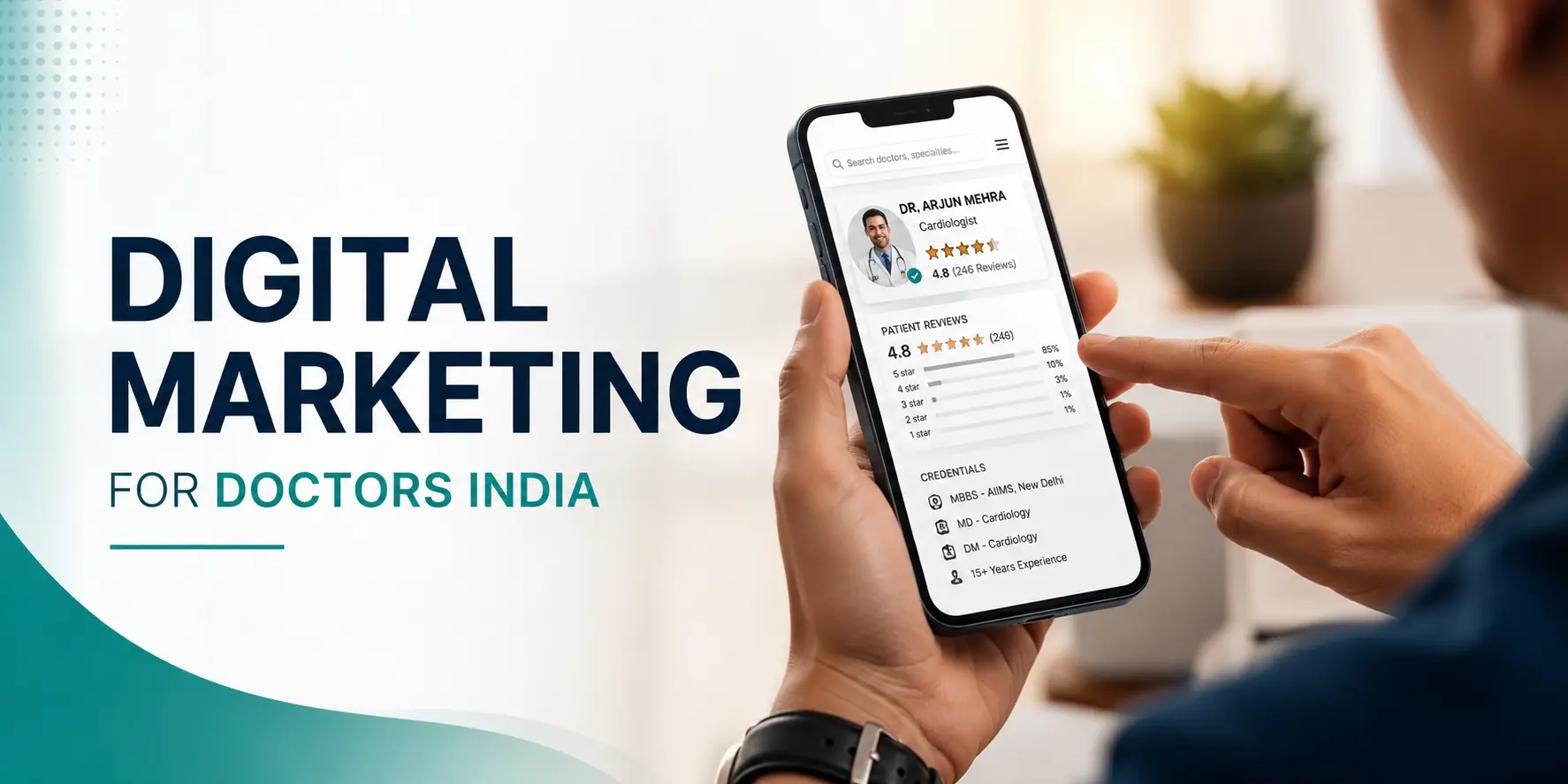
A patient with a worrying symptom doesn't call their cousin who's a nurse anymore. They search Google at 11 PM, read through a handful of doctor profiles, check star ratings, and shortlist two or three names before they even consider booking an appointment. The clinic that shows up clearly, looks trustworthy, and has genuine reviews gets the call. The one that doesn't simply doesn't exist to that patient.
That’s how most healthcare choices unfold in India today. As a result, digital marketing for doctors and clinics is no longer a side feature—it has become the primary gateway through which new patients discover care.
Even the most gifted physician can remain unnoticed if they lack an online footprint. From a potential patient’s perspective, a doctor who cannot be found online appears no different from a doctor who simply isn’t there.
This guide covers a practical, compliance-aware digital marketing strategy for doctors and clinics in India focused on what actually matters: patient appointments, not vanity metrics.
Key Takeaways
Most patients now research a doctor or clinic online before booking, comparing reviews and credentials the way they'd compare any major decision.
Local SEO and a complete Google Business Profile are the single highest-ROI investment for single-location clinics, since "[specialty] near me" searches dominate how patients find providers.
Reviews function as the modern equivalent of word-of-mouth — a steady stream of recent, genuine reviews consistently outperforms a profile with none.
Healthcare marketing carries real compliance obligations (patient privacy, no misleading claims) that generic marketing advice often ignores.
Fast response to enquiries — through call, WhatsApp, or online booking — strongly affects whether a researching patient becomes an actual appointment.
Why Healthcare Marketing Needs Its Own Playbook
Choosing a doctor isn't like choosing a restaurant. The decision involves trust, vulnerability, and often genuine anxiety, which means generic marketing tactics built for retail or e-commerce frequently misfire when applied directly to a clinic or hospital.
Trust has to be established before a single rupee is spent on the relationship, since a patient is trusting a provider with something more personal than almost any other purchase decision. That makes credentials, reviews, and clear, accurate information more important here than flashy creative or clever copywriting.
There are also real regulatory considerations. Healthcare marketing in India needs to avoid misleading claims, respect patient privacy and consent requirements, and stay within the advertising guidelines that apply to medical practice — generic marketing advice that ignores this can create real compliance risk alongside the reputational one.
Local SEO: The Highest-ROI Channel for Most Clinics
For a single-location clinic or small hospital chain, local SEO is consistently the strongest return on investment, because "[specialty] near me" and "[specialty] in [city]" searches dominate how patients actually find providers.
Google Business Profile should be claimed, fully verified, and kept complete — accurate name, address, and phone number, business hours, accepted insurance if relevant, specialty tags, and a genuine set of photos showing the facility, equipment, and team. Patients frequently decide between two similarly-rated clinics based on which profile simply looks more complete and trustworthy.
Reviews function as the modern version of a neighbour's recommendation. Encourage every satisfied patient to leave a review, and respond to every review — both positive and negative — with professionalism, since how a clinic handles a negative review is itself a trust signal to everyone else reading it.
Did you know? Clinics with consistently high review volume and strong average ratings tend to dominate the local map-pack results that appear for "doctor near me" style searches, which is often the very first thing a patient sees before clicking through to any website at all.
City and locality-specific pages matter for multi-location practices — a patient searching for a dermatologist in a specific neighbourhood should land on a page built for that exact search, not a generic "Find a Doctor" page that requires extra clicks to get to relevant information.
Content That Builds Trust and Demonstrates Expertise
Healthcare content does its best work when it answers a worried patient's question honestly, before they've even decided to book an appointment.
Educational content — explaining a common condition, treatment option, or what to expect during a procedure — builds authority and trust simultaneously. A clear, accurate piece on managing a chronic condition does more long-term marketing work than a promotional post ever could, because it demonstrates expertise rather than simply claiming it.
Doctor introduction content — credentials, areas of focus, and a sense of how the doctor actually communicates with patients — helps a hesitant patient feel like they already know something about the person they're about to trust with a health concern.
Patient success stories, shared with explicit consent, are genuinely persuasive, since they answer the unspoken question every prospective patient has: did this actually work for someone like me?
Social Media and Short Video for Healthcare

Instagram, Facebook, and LinkedIn all have a role, though the mix shifts depending on whether the audience is patients directly or, for some specialties, referring professionals.
Short, simple explainer videos — a doctor breaking down a common misconception or explaining a procedure in plain language without medical jargon — consistently perform well, since they build trust precisely by being clear and approachable rather than clinical and distant.
Hospitals and multi-doctor practices benefit from showcasing doctor expertise and patient outcomes through visual storytelling, since this builds an emotional connection that a list of services or a fee schedule simply can't.
Paid Advertising: Fast Visibility, Carefully Targeted
Google Ads can put a clinic in front of a patient at the exact moment they're searching — "best cardiologist near me," "dental implants cost in [city]" — and you only pay when someone actually clicks, which makes it efficient when targeted precisely.
Meta ads work well for raising awareness of a new doctor, service line, or health camp, targeted by location, age, and relevant interests, though they typically generate awareness rather than the same immediate intent that search ads capture.
A combined approach — SEO building long-term, lower-cost visibility over three to six months, paired with paid ads generating faster results in the near term — tends to outperform relying on either channel alone.
WhatsApp and Fast Response: Closing the Booking Gap
A patient who's done their research and is ready to book will often choose whichever clinic responds first and most clearly, particularly if they're comparing two or three similarly-rated options.
WhatsApp-based booking confirmation, appointment reminders, and quick answers to simple questions (insurance accepted, parking availability, doctor's typical hours) remove friction at exactly the point where a researching patient becomes an actual booked appointment. A slow or unclear response at this stage can lose a patient who was otherwise ready to commit.
What to Measure
Patient inquiries and appointment bookings matter more than website traffic or follower counts. Track calls generated, online booking form completions, and — where attribution allows — which channel (organic search, Google Ads, social) is actually producing appointments, not just clicks.
The Numbers Behind Patient Search and Selection Behavior:
The importance of local search visibility for healthcare providers is backed by real consumer behavior data. According to BrightLocal's Local Consumer Review Survey, 87% of consumers read online reviews before choosing a local business, and medical services rank among the top industries where people actively research reviews before making a decision. Additionally, only 48% of consumers say they would consider using a business with fewer than 4 stars.
For doctors and clinics, this means a well-optimized Google Business Profile and a steady stream of positive patient reviews can directly influence appointment bookings. When someone searches for terms like "dermatologist near me" or "best skin specialist in Delhi," Google often displays local listings, ratings, reviews, operating hours, and directions before a user ever visits a website.
Research also shows that Google remains the most widely used platform for finding local business reviews, making Google Business Profile one of the most important digital assets for healthcare practices.
In practical terms, a clinic with 100 recent reviews, a complete Google profile, and strong local search visibility is more likely to attract patients than a clinic that focuses only on social media followers but neglects its local presence. Social media helps build awareness, but local search captures patients when they are actively looking for medical care and ready to book an appointment.
How DigitalAdda Helps Clinics and Doctors Grow Patient Volume
We've worked with clinic owners to build digital marketing systems that respect the trust and compliance requirements unique to healthcare, while still focusing on what actually matters: appointments. From Google Business Profile optimization and local SEO, to compliant content that builds genuine authority, to paid campaigns and WhatsApp-driven booking flows, we build the complete patient acquisition pipeline rather than treating healthcare like a generic local business.
If your clinic has solid clinical reputation but inconsistent patient inflow, that gap is usually digital visibility, not quality of care. Learn more about our approach on our healthcare industry page.
Read next: For the local search fundamentals every clinic should have in place, see our Google Business Profile Optimization Tips guide.
FAQs
Q1: What is the most important digital marketing channel for a small clinic in India?
A: Local SEO and a fully optimized Google Business Profile, since most patients search "[specialty] near me" before booking, and a complete, well-reviewed profile dominates those local results.
Q2: How important are online reviews for doctors and clinics?
A: Extremely important. Many patients trust online reviews close to as much as a personal recommendation, and a clinic with consistent recent reviews tends to outperform a similarly-qualified clinic with few or no reviews.
Q3: Is paid advertising worth it for doctors and clinics?
A: Yes, particularly for new clinics or new service lines that need fast visibility. Google Ads target patients actively searching with high intent, while SEO builds slower but more cost-effective long-term visibility.
Q4: What compliance considerations apply to healthcare marketing in India?
A: Healthcare marketing must avoid misleading claims, respect patient privacy and consent — particularly when sharing testimonials or before/after content — and stay within applicable medical advertising guidelines. This is a key reason healthcare-specific marketing expertise matters more here than in many other industries.
Q5: How long does it take to see results from healthcare digital marketing?
A: SEO typically takes three to six months to show significant results, while paid advertising can generate patient inquiries within the first week. Most successful clinics combine both for immediate and long-term results.